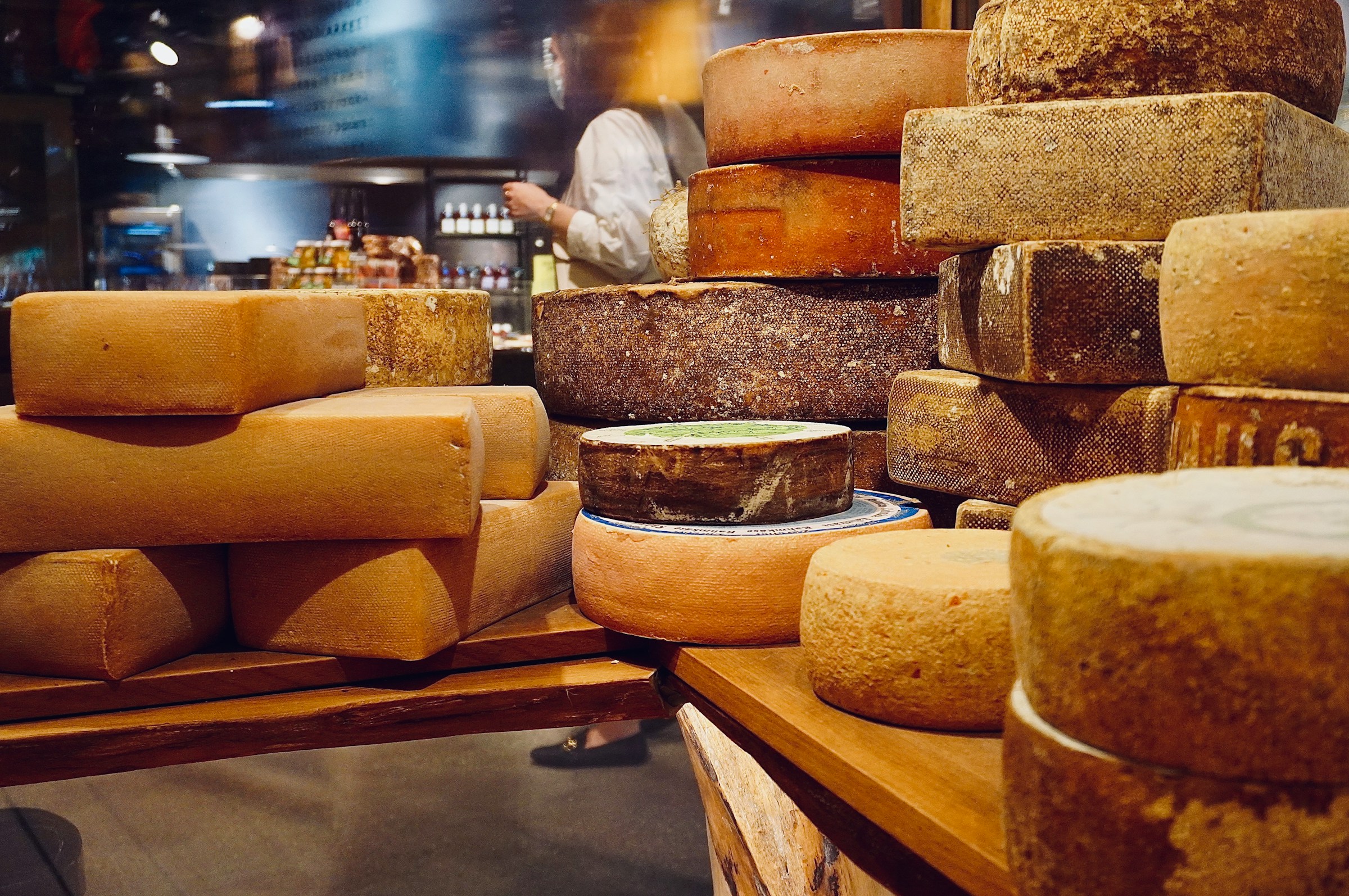
Cheese begins with a fairly brilliant idea: take milk, which does not last very long, and turn it into something you can keep, carry, share, slice, spread, grate, melt, hide in a sandwich, put on a board, and occasionally smell from the next room.
Put like that, it is easy to understand why humans never really let it go.
At the beginning, cheese was not a luxury product. It was not about fancy restaurants, difficult words, or people talking about fresh hazelnuts with a very serious face. It was much simpler: humans had milk, milk spoiled quickly, and they found a way not to waste it.
The miracle is that this practical solution became one of the most fascinating foods in the world.
So what exactly is cheese?
At its simplest, cheese is milk that has changed state.
You start with milk from a cow, goat, sheep, buffalo, or another dairy animal. You make it curdle: the liquid separates into two parts. On one side, the curd, which is more solid. On the other, the whey, which is more liquid. Then you drain it, salt it, sometimes press it, sometimes heat it, sometimes let it live quietly for weeks, months, or even years.
The official definition is, of course, more serious than that: it talks about the coagulation of milk proteins and the removal of whey. 1 But for now, keep the simple picture: cheese is milk that has been helped into becoming something else.
And that something else can go in a thousand directions.
A fresh cheese can be soft, moist, and ready to eat right away. A large wheel can spend months in a cave before it becomes truly interesting. A blue cheese needs air inside its paste to develop its veins. A washed rind needs regular attention. Mozzarella has to be stretched in hot water. Comte has almost nothing in common with fresh goat cheese, and yet both begin with the same basic idea.
Milk. Microbes. Salt. Time.
That is the starting team.
Who invented cheese?
We would love to have a neat answer.
A name. A date. A country. The first historic bite.
Unfortunately, cheese did not leave a business card.
There is an old story people often tell: someone carried milk in a pouch made from an animal stomach. Because of the enzymes naturally present inside, the milk curdled during the journey. At the end of the trip: surprise, the milk had become a white mass separated from its whey. First cheese, applause, end of story.
It is a lovely scene. It is possible. But we cannot prove it.
What is more likely is that cheese was not invented once, by one person. It probably appeared gradually, in several places, among people who lived with dairy animals and paid attention to what was happening.
Milk left alone can ferment. It can become acidic. It can curdle. If you drain that curd through cloth, skin, a basket, or a pierced container, you get something nourishing, denser, and easier to keep than fresh milk.

No lightning bolt of genius required. Sometimes history moves forward because someone takes a good look at what happened in a bowl.
The first cheese probably did not look like Comte
This matters, because we often imagine cheese through the ones we already know.
The first cheese in history was probably not Comte, Roquefort, Gorgonzola, Manchego, or Cheddar. Those cheeses came much later: places, techniques, habits, rules, and generations of people slowly refining the gesture.
The very first cheese was probably much more modest.
Most likely a fresh curd. Moist. A little acidic. Maybe eaten quickly. Maybe salted if salt was available. Something between drained fermented milk and a very simple fresh cheese.
We cannot be certain, because this kind of product disappears without leaving many traces. A fresh cheese eaten nine thousand years ago is not politely waiting for us in a museum case. But it is the most reasonable guess: dry, pressed, cooked, or long-aged cheeses require more control. Fresh curd can happen quite naturally. A wheel built to last is a much bigger project.
So if we had to sum it up: the first cheese probably had no name, no beautiful rind, no official rules, no label. But it already had that incredible power: turning fragile milk into food.
The oldest known traces
Cheese archaeology is a fairly ungrateful job, because cheese is eaten, degrades, and disappears. We almost never find “the cheese” itself. We find clues.
Researchers have shown that milk was already being used around nine thousand years ago in northwestern Anatolia and southeastern Europe, thanks to fat residues preserved in pottery. 2 That does not mean all that milk became cheese, but the scene is set: humans were already milking animals very early in agricultural history.
For cheese more specifically, one of the most famous pieces of evidence comes from perforated pottery found in present-day Poland, dated to the sixth millennium BCE. Its shape looks like a strainer or cheese mould: useful for holding curds while whey drains away. Residue analysis points in the same direction. 3

In Croatia, on the Dalmatian coast, other traces suggest that around 5200 BCE some vessels were used to transform milk into fermented products, probably including cheese. 4
These are very old clues. But careful: they do not mean “cheese was born in Poland” or “cheese was born in Croatia.” They mean that in those places, at those dates, we know people were already doing something that looks strongly like cheesemaking.
Cheese may be even older. It may have been made using materials that do not survive well: skins, cloth, plant baskets. No trace does not mean no cheese. It just means the past did not keep everything for us.
Why was it such a good idea?
Because milk is wonderful, but not very patient.
Transforming it buys time. By draining the curd, you remove some of the water. By salting, acidifying, drying, and aging, you make the product more stable. Cheese concentrates what is precious in milk: protein, fat, energy.
For herding communities, that is huge. You can save part of the production. You can transport it. You can get through less generous seasons. You can feed a family or a group without having to drink all the milk immediately.
There is also the question of lactose. Many adults in early European populations probably did not digest fresh milk as easily as some adults do today. Fermentation and draining can reduce some of the lactose. Cheese may therefore have made milk easier for more people to eat, even if the full story of lactose digestion is more complicated than that. 5
And then there is one simple idea: a dairy animal can produce milk again and again. You are not getting food from the animal only once. You are creating a resource that returns, transforms, and becomes part of everyday life.

Before cheese was delicious, it was sensible.
Luckily for us, sensible can taste extremely good.
How cheese travelled
Cheese did not spread like a printed recipe that everyone followed exactly.
It travelled with animals, families, shepherds, merchants, villages, roads, and habits. Wherever humans kept animals for milk, they invented ways to drink it, ferment it, drain it, and preserve it.
And each place changed the result.

In a hot climate, you do not make cheese exactly as you would in a cool mountain region. Sheep's milk does not behave like cow's milk. A humid cave, a source of salt, a wooden mould, a cloth, a market habit: all of it starts to matter.
That is why cheese is so local, even when the basic idea is universal. It always says something about where it comes from.
We find traces in places very far from each other. In Egypt, a roughly 3,200-year-old residue discovered in the tomb of Ptahmes contained milk proteins from cow and goat or sheep. 7 In the Tarim Basin, in China, masses placed with buried people around 3,600 years ago have been identified as a fermented cheese related to kefir. 8
These are not direct ancestors of the cheeses we buy today. They are more like evidence of the same intuition, repeated in different cultures: milk can become something else, and that something else is worth keeping.
And modern cheeses?
The cheeses we know by name came later.
Much later.
A famous cheese does not appear all at once, perfectly finished, with its logo, shape, and Wikipedia page. It is built slowly. People repeat a gesture. They improve it. They pass it on. A region becomes known for a way of making. A market prefers a certain format. A cave gives good results. A technique becomes a tradition.

The big families take shape over time: fresh cheeses, soft cheeses, pressed cheeses, blue cheeses, brined cheeses, washed rinds, stretched-curd cheeses. These are not school categories invented to make life boring. They are answers to very practical questions.
How do we keep milk longer?
How do we transport cheese?
How do we get a paste that is drier, softer, meltier, stronger?
How do we use the milk available here, with this climate, these caves, these animals?
Modern cheese grew from that accumulation. One simple starting idea, then thousands of variations.
The living world inside
For a very long time, humans made cheese without knowing exactly who was helping them.
They could see that milk fermented. That one cave produced better results than another. That a rind needed rubbing. That a little old whey, starter, or culture could help a new batch. But they could not see bacteria, yeasts, and molds.
Cheese was already a microbial business. The microbes simply had not been properly introduced yet.
In the nineteenth century, Louis Pasteur's work on fermentation helped explain the role of microorganisms. 9 Later, cheesemakers learned to select starters, control temperatures, make production safer, and obtain more regular results.
But even today, cheese is not a completely obedient object. Milk changes with the animals, their feed, and the season. A cave lives. A rind evolves. Microbes transform texture and aroma. Recent research even shows that some cultures used in cheesemaking carry signs of long domestication: by choosing and reusing them, humans also shaped the microbes of cheese. 10
That may be the most beautiful part: cheese is made by humans, but it is never completely still. It moves, matures, changes its mind.
Why this site exists
Because cheese deserves more than two lines on the back of a label.
There are the cheeses themselves, of course. But there are also the people who make them, the people who raise the animals, the people who age them, the people who sell them, and the people choosing what to put on the table. There are gestures, countries, regions, seasons, mistakes to avoid, good surprises, classics, oddities, cheeses we think we know, and cheeses we have never heard of.
Eat Good Cheese exists to follow all of that.
Not to turn every bite into an exam. Not to pretend everyone needs to know every cheese family by heart. More simply: to make you want to look, smell, taste, compare, and understand a little better.
If you already love cheese, you are in the right place.
If you know nothing about it, or think you do not like it, we will try to fix that.